-
some new scores
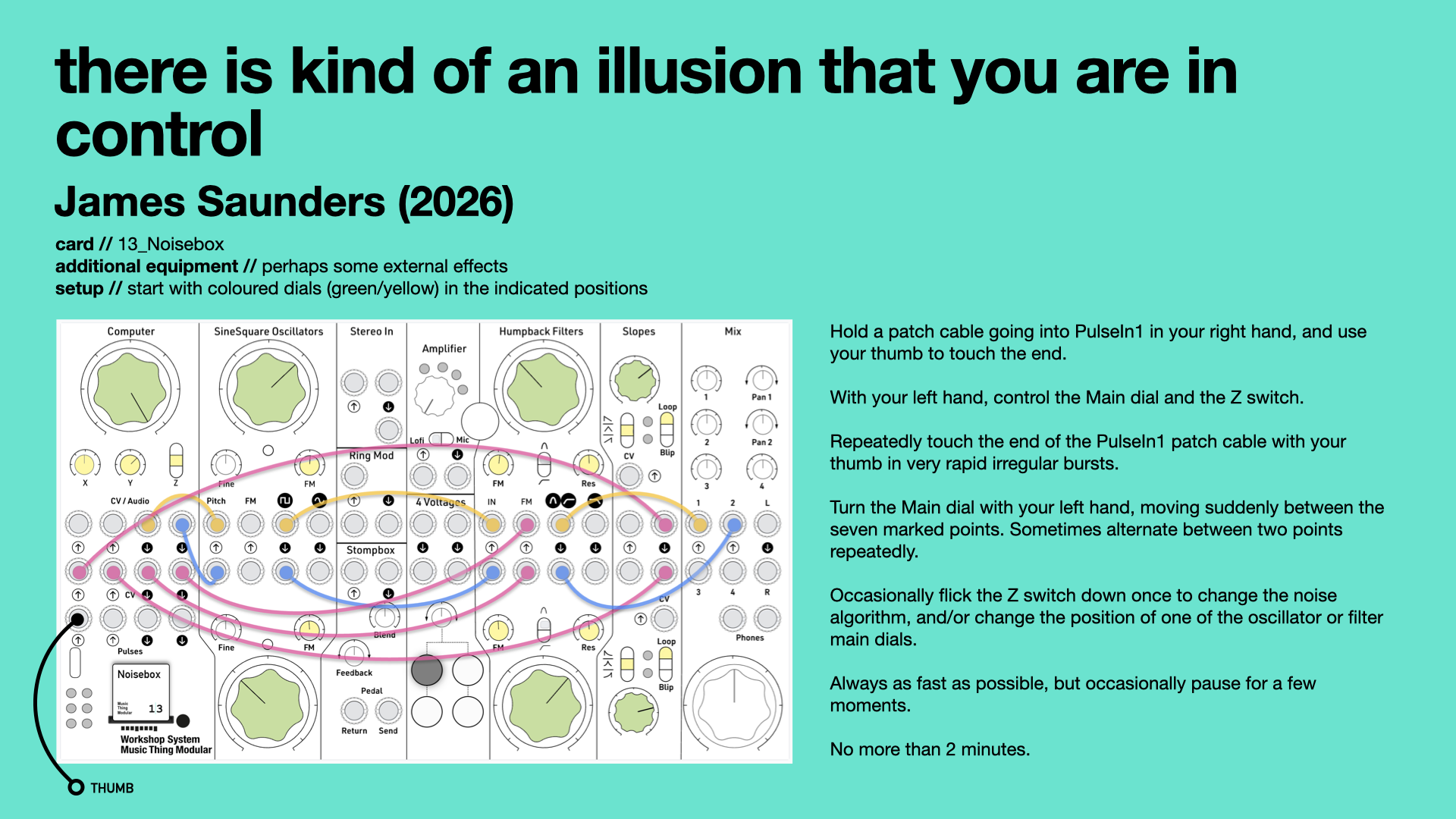
I’ve been making programme cards for the Music Thing Modular Workshop System over the summer, and have just made a set of pieces, titled the purpose of a system is what it does, that you can play on it, using my cards and those by others. The pieces are all bespoke for the system, but the processes are aligned with my interest in institutional processes, and especially the way we don’t always have a lot of control over them. So the pieces all use the fact that modular synths allow you to get close to something, but have a habit…
-
the bells
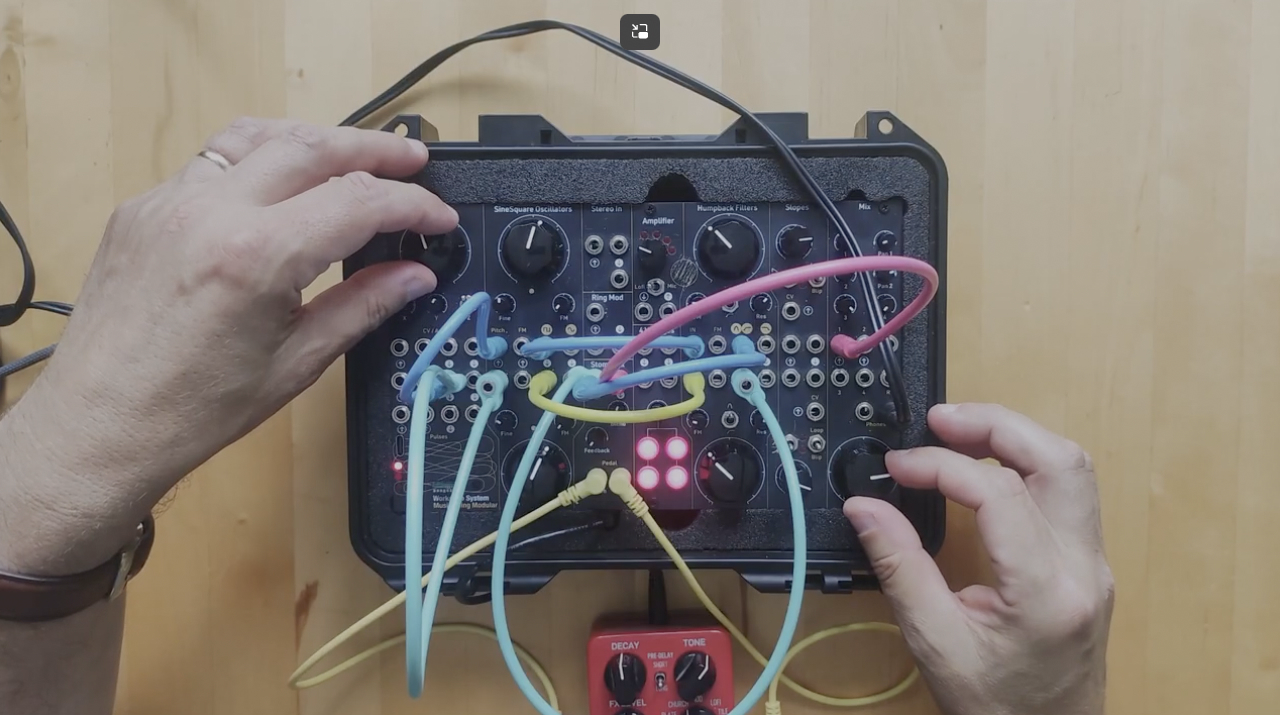
Here’s a short demo video for the Modular Music Thing Workshop System computer card I made last month. I’m having so much fun making these, and have a few others on the go at present. There’s a really great community on the Discord developing work for the system, and I’m finding it sits in the perfect place between ideas and realisation for someone with limited coding skills (i.e. Claude). There are some real bell samples we made in the card too. What’s not to like.
-
performing tasks we’d like to hear
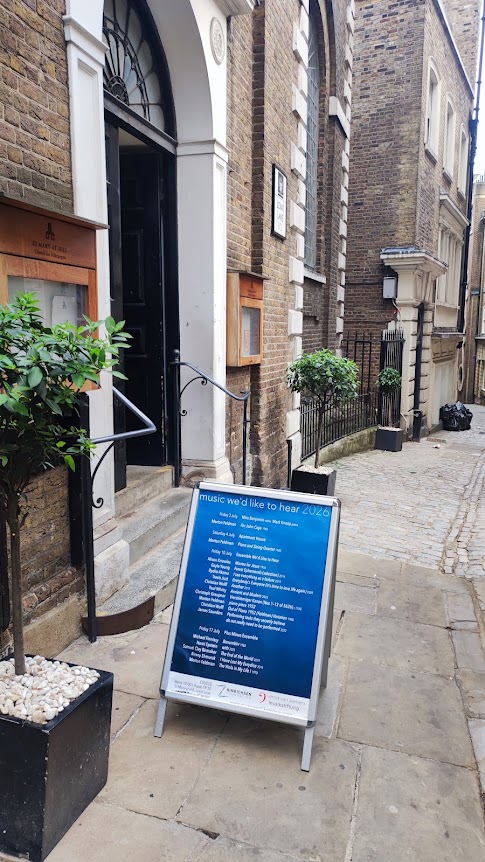
We had a lovely time performing my piece performing tasks they secretly believe do not really need to be performed at the amazing music we’d like to hear in July. It was fun to try it for a second time with new people, and to see so many old friends in the ensemble and audience, although it made me feel a little old at times. There’s a video here – with thanks to James Creed for the audio.
-
ordinary objects
Following the Immediate Pieces project I did with CoMA last year, we’re collaborating on a new one over the next few months called Ordinary Objects. The project addresses their need for new compositions which are useable by a wide range of people who may not have access to conventional instruments or training in music. CoMA’s work is central to developing inclusive collaboration in music through their extensive programme of work with composers, performers and audiences in communities across the UK and beyond, with a special focus on non-professional, untrained or first-time musicians. Their aim to reach new and more diverse…

-
actual project
I’ve not updated the site for a while, but I’ve also finished the piece for Zubin Kanga now, as part of his Cyborg Soloists project. The piece is called just trying to do what I’m told and keep up and do the best that I can and puts the pianist in an increasingly difficult situation where they are asked to respond to a series of instructions which get progressively harder to follow. The piece reflects on the experience of managing situations where the flow of information and requirement to respond accurately and efficiently becomes overly taxing and impossible to maintain.…

-
side project (part 2)
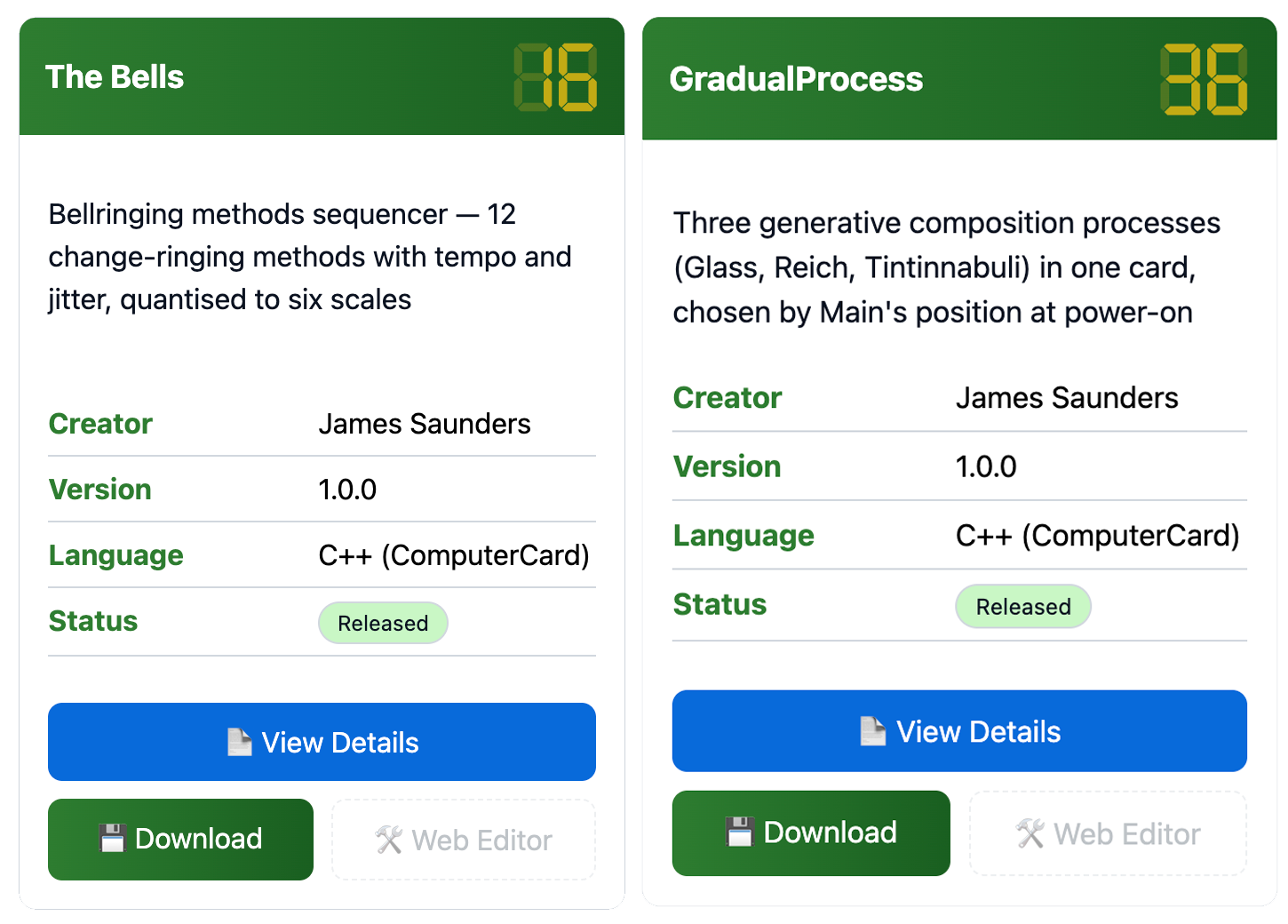
After making the prototype eurorack module The Bells I messed around for a bit with Daisy Seed to see if I could get the canon module working better (it was built variously on an Arduino Nano Every and Teensy 4.0 while developing). But then I bought the kit of Tom Whitwell’s Music Thing Modular Workshop System which is properly amazing. I love a self-build kit, although soldering while the temperature was 34 degrees was probably not a good idea. I started messing around wiht the cards for the computer part of the system and found that The Bells transferred really…
-
side project (part 1)
Over the past year I’ve been building some prototype eurorack modules. I’ve always been curious about how to do it, and on the off chance asked Claude how to start. A couple of months later I’d made The Bells, a CV generator that models bellringing methods to produces sequences of permutating pitches. It includes variable tempo, choice of scales and pitches, and gate out for each of the eight voices to cue a sampler. I made it using Claude Code – and a number of other AIs when my credits timed out – to design the hardware, firmware, and troubleshoot.…

-
immediate music
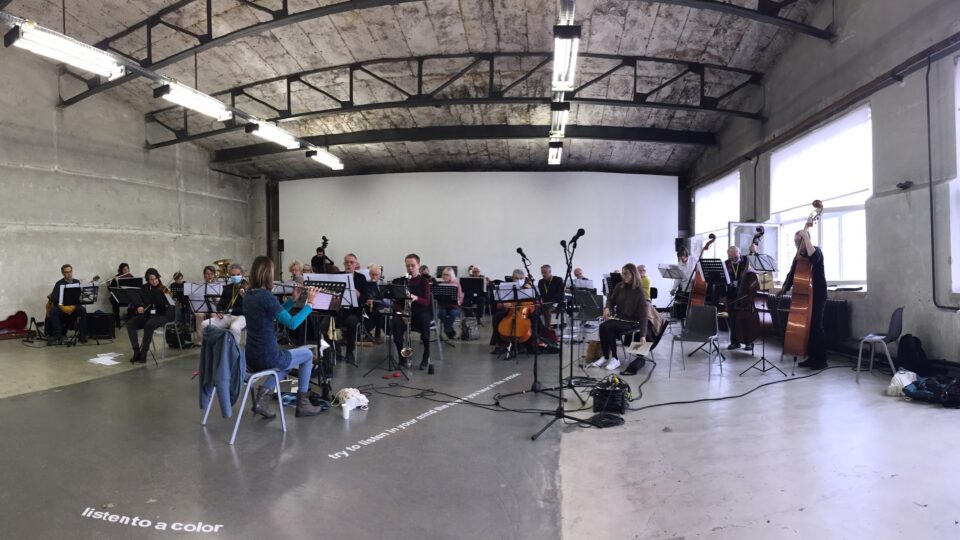
I’m working on a project with CoMA at the moment to create a collection of pieces that can be performance-ready in under an hour, and suitable for players from a wide range of backgrounds and experiences. I’ve found it useful to have pieces available that can be put together quite quickly from scratch when working with our students, and wanted to develop this into a resource that others could use in education, community and performance contexts. I’m working with Emory and Tamara at CoMA to source pieces through their collection, other scores I have access to, and a call for…
-
paper loop
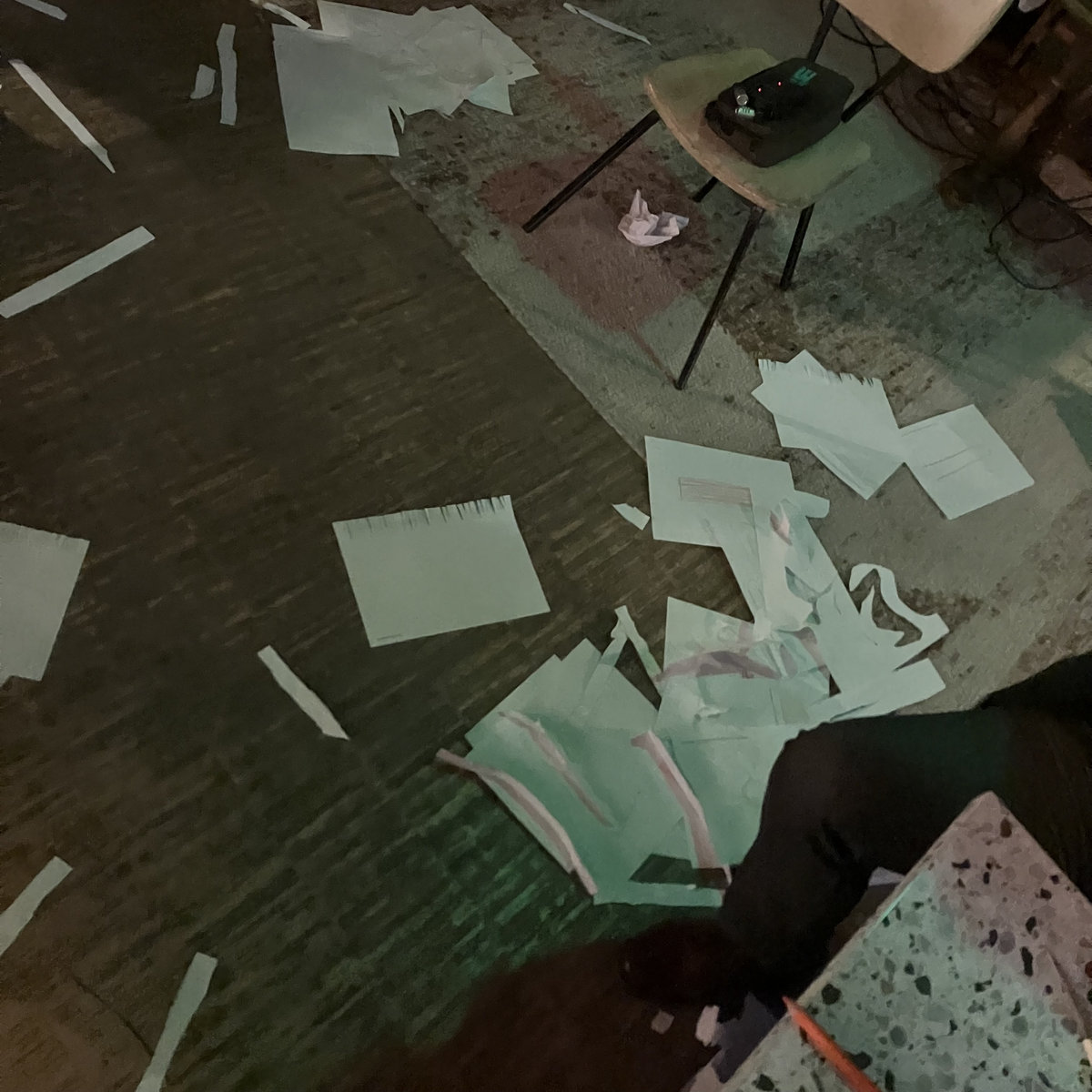
Philipp Overberg sent me this edited recording of a version of my piece with paper realised in Münster on 10 April. He says it’s a ‘Layered field recording of an originally 20 minutes performance of James Saunders’ “With Paper” at “The Auditory Canal”, Café Yolk, Bennohaus Münster, cut up in 4 tracks of 5 minutes played back simultaneously. This collage also contains ambient noises from the staircase, bar, toilet and surrounding chatter and music. It was originally intended as a 5 minutes tape loop used in an OTB live performance.’ It’s lovely to hear what he has done with it;…
-
moments of respite
On Saturday Huw Morgan repeated a performance of the organ piece I wrote for him in 2023, amongst it all, some occasional moments of respite, at All Saints Clifton in Bristol. Quite a sense of deja vu as it was the same venue as the first performance. The performance was part of Huw’s amazing mainly slow organ music series, which is now up to event 41. It’s an amazing endeavour and has seen a lot of new pieces made, which is great. In the concert on Saturday there were also some lovely new pieces by Richard Hughes, Ben Jameson and…

-
something happens
Yesterday was the first performance of the piece I’ve been making with soundinitiative over the past few months. I’m very excited about this one as it finally brings together a lot of the things I’ve been working on over the past 10-15 years and is the beginning of a new modular system that sets up a flexible format in the same way as my older #[unassigned] project. The piece is titled something happens then something else happens then all sorts of other things happen and it comprises a set of (currently) 50 states, each of which specifies a particular type…

-
I just made three new pieces
After quite a long development period, like buses, three new pieces have come along at once. Since the beginning of the year I’ve completed pieces for soundinitiative, Zubin Kanga, and a commission for the Only Connect festival in Stavanger.The first two are being performed soon, but the piece for Norway was for a supergroup combining asamisimasa, Insimul, Kitchen Orchestra and organist Nils Henrik Asheim. It was performed last week at the Stavanger Konsertuhus, which is an amazing space. Hopefully there will be some documentation soon. The piece has a preposterously long title again, and this one I’m really struggling to…

-
making choices in Glasgow
CoMA Glasgow did a couple of versions from my piece making a choice and then making another choice (2021) at the Scottish Music Centre in December. This is the first time the piece has been played live to my knowledge, as it was originally made for the Parkinson Saunders online event during Covid. Lovely to see some choices being made in a number of different ways.

-
new piece for soundinitiavie
I’m just about to start working on a project with soundinitiative in Paris for 2024-25, and the production has just been funded generously by diaphonique, having been selected by the 2024 Artistic Committee. Diaphonique fund music collaborations between France, UK and Ireland every year. Our project involves me developing a new modular composition structure that will generate pieces that continue my exploration of group behaviours. We begin working in Paris on October 2024, and then develop work with students at Conservatoire Aubervilliers and children at La Maison Départementale de l’Enfance (Cergy), as well as concert presentations of the work. I’m…

-
self-evident music
Last week I was at the TENOR24 conference in Zürich, hosted by the ZHdK in their amazing building. It was a great conference with some lovely people and I came back with lots of new ideas. I was presenting a paper on perfect information, making connections between games and instruction scores (again…) as a possible way to describe recent approaches to self-evident music. For me, this is work that makes a feature of its mode of operation, seeks to clarify rather than obscure (mostly), and in which processes are surfaced, and even reflexive. They might be thought of as obvious,…

-
performing tasks they secretly believe do not really need to be performed
I’ve uploaded a video of my piece performing tasks they secretly believe do not really need to be performed from last year. The performance was at the Theater Basel as part of the SPIEL! festival organised by the Musikakademie. Thanks to Michel Roth for organising it, all the volunteer performers, and for the sourcing of lots of cardboard boxes. We discovered on the morning of the performance that the massive collection that had been assembled had been recycled by the caretakers in a tidy up, so we had to find a load more very quickly.

-
getting lost
I’ve been working on a few new pieces over the first half of the year, developing some ideas involving looping structures that have been present in a number of pieces recently. I’ve been using nested loops to create multiple ways to move around a set of materials since the quartet I made for the Ardittis in 2013. More recently, this has developed into more maze-like puzzles, where the player(s) must find particular routes through the material in order to satisfy certain conditions. There are four pieces so far, starting with an organ solo made for Huw Morgan and followed by…

-
mainly slow organ music
Huw Morgan played my first organ piece – amongst it all, some occasional moments of respite – at All Saints Clifton in Bristol on Saturday. The performance was part of his mainly slow organ music series in which he has presented a load of new pieces, a lot of which were written for him. The concert on Saturday also included a really great new piece by Dante Boon, and it was lovely to meet him at last. Both our pieces dealt with repetition, settling and navigation in different ways. There is a recording of the performance on bandcamp, and the…

-
Making some new pieces
This year has been a little quiet, so it’s lovely to be making a couple of new pieces for early 2023. In January I’m heading off to the Spiel! festival in Basel with a new piece that will involve volunteers from the festival participants in the Theater Basel. Then in March I’ll be in Oslo working with Masters students from the Norwegian Academy of Music at the amazing Munch museum. Both pieces are flexible and open to a wide variety of participation approaches, and I’m just working on the material for each at present, having got the basic processes in…

-
Some new videos
We made our first Open Scores Lab TV studio project after Covid last week, recording four new pieces by Lab members. It was great to be working with the studio crew again, and we had a fun couple of days trying out some new kit and making some sounds. We recorded two new pieces by Harry Matthews – Distraction Piece and Home and Away Chords. Distraction Piece features visiting research fellow Elliot Simpson on guitar playing some Luis Milan (very beautifully!), while Harry, me, and Caitlin Rowley go to increasingly desperate lengths to distract him. He’s just too good though.…

-
I wrote something.
I’ve just had an article published in Contemporary Music Review as part of the volume that emerged from the Performing Indeterminacy conference in Leeds in 2017. Lovely that it is now out and available, and it can be accessed at the CMR page. The abstract is below. What’s the Point? Balancing Purpose and Play in Rule-based Compositions The paper applies theory drawn from game studies to music composition in order to consider ways in which rules and goals create environments that promote critical play and manage the balance between purpose, play and task subservience. It explores correspondences between rules in…

-
Klangwerkstatt video
The video of my piece it is the behaviour a system tends towards and encourages that needs to be understood is now online at the Klangwerkstatt festival site and channel. There are also loads of videos of all the pieces in the festival to check out too.

-
some old new pieces
I’ve just uploaded three pieces I made last year which needed a bit of an edit. They are all a little outside of some of the things I’ve been doing recently but good to add them now. The first is a set of looping guitar pieces called nine labyrinths, although strictly speaking they are mazes. They extend a looping system I’ve been working on for a while, which presents multiple interlocking routes through a line of material The second is a set of canons for multiples of the same instrument, currently double bass, guitar, clarinet, trumpet and piano. The canons…

-
What do composers do all day?
The article Matt Sergeant and I put together on the mundane aspects of composing is now out in MusikTexte (173, May 2022). We’ve been thinking about the way all the things that surround what we do as composers shape what we make. So this might include what pen you use, where you work, if you work early in the morning, at a desk, in bed, what distractions you need, and everything else. We sent a provocation to a few composers and the article includes our initial text and their responses. The variety is really lovely, and we were so grateful…

-
some new things
It’s been quite a busy few months outside of making pieces, so I’ve been glad to have a break over the past couple of weeks to take stock. The most exciting thing is: I’ve just got to the end of a notebook and have started another one. That’s how thrilling my life is. I’ve also started using my fountain pen to write with which is lovely as a change from the equally excellent MUJI pens I tend to use. I’ve gone back to using an A5 Midori MD blank notebook as it has great paper and is a different aspect…

-
TIME IS OVER released
I’m very excited to see that Tim Parkinson and Travis Just’s joint release TIME IS OVER is now out, and it includes the recordings we made of Tim’s songs 2011 as Parkinson Saunders in Bath in 2013. It’s lovely to hear these as I’d not listened to them for a while, and it’s great to know that at least once we nailed each of the songs. You can hear the album on Bandcamp, and also buy one of the limited 300 CDs there too. Have a listen, and then listen to more of Tim and Travis’s work.

-
Together in music book chapter published
I have a chapter in the new OUP volume Together in Music, edited by Renee Timmers, Freya Bailes and Helen Daffern. The book emerged from the conference of the same name held in York in January 2018, at which I was one of the keynote speakers. The event brought together a fascinating range of contributions from speakers that explored the social aspects of music making and their role in ensembles. The book itself presents many of these (36 chapters!), and I’m looking forward to seeing where some of the work presented three years ago has ended up. My chapter is…

-
Klangwerkstatt 2021
The programme for November’s Klangwerkstatt in Berlin is out now, and includes the piece I am developing with KNM Berlin, KNM Campus Ensemble and the CoMA Allcomers Orchestra. We’re playing at Fahrbereitschaft Berlin on Saturday 13 November at 2000, and the programme also includes pieces by Joanna Bailie, Alexander Campkin and Stefan Streich. The event listing and full programme are here.

-
Hausmusik Kollektiv
I have a piece in Claudia Molitor’s lockdown book Hausmusik Kollektiv, published by Colin Sackett. My piece, evolution occurs slowly or not at all, was made in early 2020 from an exercise we did with the postgrad composers at Bath Spa. The piece is participatory, and features a collection of sound files that may gradually transform over multiple generations as participants recreate combinations of existing files using other means. If you want to have a go, the score is available here, and Claudia’s original website collection of all the pieces is here.

-
split attention
The video of NTNU Sinfonietta’s performance of you are required to split your attention between different sources of information is now up on their website here, or you can watch it directly on Vimeo here. Thanks again to everyone for playing the piece!

-
NO CONCERT
We just screened a Parkinson Saunders online video streaming performance thing for here.here, hosted by Iklecktik. Emmanuelle Waeckerle and Harry Whalley at here.here (a project out of UCA) invited us to do a live show, but we ended up making a set comprising new video pieces (Tim) and video realisations of performances (me). We made a few other bits and pieces which we’ll upload soon as well, but the video of the full livestream including the Q&A is below, and beneath that the video on its own. Thanks to Emmanuelle, Harry and Isa for inviting us to do this.

-
Parkinson Saunders at here.here and Iklecktik
We’ve just about finished sorting out our show for the here.here event hosted by Iklecktik next week. It’s a 30 minute set of video pieces we’ve been developing over the past couple of months, involving the normal mix of speaking and moving things about on tables, but there are a few new skills we’re deploying this time. I say skills, but perhaps hobbies or activities might be more accurate. Mostly though we’ve been enjoying making some more filmed pieces continuing on from some of the work we made last year during the first lockdown. The event goes out on Iklecktik‘s…

-
split attention in Trondheim
This week saw the second performance of the piece I wrote for the Arditti Quartet and Ensemble Modern in 2018 for Wien Modern. I’ve been working online with Michael Duch and musicians at NTNU in Trondheim in preparation for the performance at Only Connect, Ny Musikk’s new music festival. The piece, you are required to split your attention between multiple sources of information, was performed in the opening concert at Vår Frue kirke in Trondheim. This version was made especially for the group, with the names of the players being used to direct specific cues. We’ll have a video available…

-
Time’s Arrow play some pieces
Rodney Lister’s ensemble Time’s Arrow at Boston University have been working on online versions of some of my pieces recently and have made the videos available as below. There are some versions of people do things apart from last year, as well as some ensemble versions of my sequence studies. Great in particular to see those attempted by a large ensemble. Thanks to Rodney and the group for their work on these!

-
lots of stuff
I’ve been doing a few updates to the site this week, mainly making sure all of the pages for my pieces are up to date. On all the composition pages there is a recording or video where I have them and images of the score (which can also be downloaded from the scores page, although this also needs an update). While doing this I’ve also added in pages for some older pieces, especially the very short compositions I wrote between 1996-2000, including my orchestra piece Like wool. The ridiculously proportioned score is also there. I have some plans to develop…

-
routine and keeping going
I’m reading Mason Currey’s excellent Daily Rituals: How Artists Work at the moment, and have just changed my daily routine as a result. The book is endlessly fascinating, examining the range of approaches writers, musicians, artists, and others use to get through the day having accomplished something. It’s pretty reassuring as everyone has a different way to do this, involving working in the morning, afternoon, evening, at night, in bed, in cafes, before eating, having drunk a lot, and many other peculiarities. Personally, I’ve always tended to sit down at about 10-10.30 at night and work then, but increasingly I’m…

-
stop me if you think that you’ve heard this one before
The video we made of Paul Whitty’s stop me if you think that you’ve heard this one before is now available on the audiograft website after its screening tonight (video is also below). The piece involves working through repertoire that forms the performance history of the instruments being played, using a number of different reading strategies to break the music into a sequence of single isolated pitches. The players were Paul, me, Austin Sherlaw-Johnson and Tim Parkinson. I used as many fretted instruments as I could, and my realisation includes classical guitar (the one I’ve had since I was seven),…

-
The Assembled do things apart
I’m very excited to be joining The Assembled on Monday 15 March for their streaming performance which includes my piece from last year, people do things apart. The performance is on Zoom starting at 6pm GMT and includes pieces by Pauline Oliveros and Morton Feldman. The Assembled are based at University of York and are directed by Catherine Laws. The lovely poster was designed by Gaia Blandina, who will be performing in the concert (live from Sicily). You can join the performance at http://tiny.cc/assembledkeycollection

-
design
Yesterday we started a new topic in our postgrad composition seminar at Bath Spa, focusing on design. This has started me thinking about some aspects of my working methods and practice more widely. Matt Sergeant opened up some really amazing ideas about the nature of design and how we might apply it to what we do as composers, and I’ve kind of come to the conclusion that what I am doing most of the time is designing. We talked in particular about the relationship between conceptualising, designing and realising, although as a group I think we are all considering those…

-
open scores lab online
After sorting out my website, I’ve also finally made an update to the Open Scores Lab pages to reflect what’s going on at the moment with the group. We’ve had a slight change over the past year, with the previous Wednesday sessions turning into more of a weekly visiting composer talk, some of whom are a little more in the OSL area, other less so, but we’ve had some really amazing people talk about a wide range of work. We’ve moved the main lab sessions to Fridays online, and the group is really great, with our amazing PhD composers, Matthew…

-
two things online.
I’m dropping in on a performance by The Assembled from York on Monday 22 March as part of their streamed performance. As well as pieces by Pauline Oliveros and Morton Feldman, they will be playing my piece from last year, people do things apart which was written for an online video call. It’s with a slightly smaller group of players than the first performance we did last year, but that should change the dynamic considerably. I’ll be controlling the muting again, which feels a little uncomfortable given all the players are female. I think this is the first time a…

-
I changed my website.
I just made a big theme change to my site, which took a little longer than anticipated. I nearly switched over to Squarespace, but in the end found it was possible to make pretty much the same thing in WordPress for a lot less cash and keep the amazing tech support from my host krystal.co.uk (they are seriously good if anyone is looking for a host). I’ve still got a few pages to edit to make them work in the new layout, but will have some fun with this over the next few months. I should really start posting some…

-
interview for neue musik leben
A couple of weeks ago Irene Kulka interviewed me for her podcast Neue Musik Leben, and the episode is now out. It is a slightly more chatty interview and wider ranging than just talking about pieces, which was fun to do. Thanks to Irene for a lovely chat. It’s part of a really great series, and the current batch includes interviews with Juliet Fraser, James Weeks, and Tim Parkinson.

-
things to do at a distance
Well I finally made a lockdown piece. After all the seminars, tutorials, and meetings I’ve been involved with, it seemed like a good idea to make a version of things to do which uses video chat as a medium. So last week we recorded people do things apart. I was really pleased to get together such a great group, and we nearly had a few more but personal situations, work, technology failure, and time zones conspired against us. In the end we had an ensemble of 12 comprising Nomi Epstein, Larry Goves, Louis d’Heudieres, Mark Knoop, Rebecca Lenton, Thierry Madiot,…

-
Distance learning
I’ve been making a new series of pieces with Tim over the past month or so which play with remembering sequences of actions in different ways. The series is called sequence studies and there are five to start with. They all have sequences of instructions read by artificial voices, and we respond once each sequence is complete. The different studies deal with ways of taxing us, including expanding sequences, swapping objects, multimodal cues and so on. We filmed them separately in response to the audio track and then synchronised the video. Some we do quite well, and some are fairly…

-
Tectonics piece on iPlayer for a bit
BBC Scottish Symphony Orchestra have made a lot of their Tectonics archive available on iPlayer for a few weeks. The piece I wrote in 2017 for Parkinson Saunders with the orchestra, alternate between attention and ease, is now available to view. Lots of other amazing stuff there too! Really great to see all this archival footage being released: it would be great if it just stayed there permanently.

-
new videos
Tim and I have been making some new videos over the past couple of weeks. We started by making versions of two pieces we have played a lot live: Tim’s two cardboard boxes and Alvin Lucier’s Opera with Objects. Both work well as unsynchronised independent recordings, and we just edited them together. We also raided the back catalogue from the very beginning with a video version of Button Moon, the piece (I think?) we made together in Ostrava in 2001 prior to starting a duo. It evolved out of playing random alternating notes on a couple of grand pianos we…

-
Spring cleaning
I’ve spent the last couple of days doing a little tidying up of online things that I have some sense of control over. So this includes: Updating my main website and sorting out some things that needed reformatting. So there is now a videos page that brings together all the videos I have of my own work, Parkinson Saunders stuff, and other things. I’ve also updated all my score listings to include everything I have for free download. I’ve made links in the menu to my Bandcamp page, and the new Parkinson Saunders tumblr where we’re sticking all our videos.…

-
Hausmusik Kollektiv
I’ve just added a piece to Claudia Molitor’s Hausmusik Kollektiv, a collection of scores designed for home use. My piece is new(ish), and titled evolution occurs slowly or not at all. It stems from an exercise we did in the MA class at Bath Spa at the end of last year. It presents a collection of sound files that may gradually transform over multiple generations. The project is open to distributed participants who select any two of the available files and listen to them simultaneously while trying to recreate what they hear using any sound-producing means. Participants record their recreation…

-
We made a Parkinson Saunders site.
It’s just a few videos for the moment, but after making a Parkinson Saunders site that we never updated a few years ago, we decided to make a new one on tumblr. We’ve just started making some videos of pieces where we record each part independently, starting with Tim’s two cardboard boxes, so will put them here, amongst other places. Other things might appear too. Anyway, here it is: https://parkinsonsaunders.tumblr.com/

-
paper opening
Caitlin Rowley sent me this lovely picture of the remnants of with paper which she performed today with Vassilis Chatzimakris, Oogoo Maia and Robert Luzar at the opening of out new Locksbrook Campus. Really pleased it was played there as the link between the sonic and material aspects of the piece seemed fitting.

-
A little bit of Parkinson Saunders
Tim and I are doing a set at Audiograft in Oxford on Friday 20 March. We’ll be doing two new pieces, one by each of us, and a new piece by Paul Whitty. My piece is called conversation with activities, and involves us having a chat while doing a lot of other things which distract us. Details on the audiograft website. Come along!

-
new performance of radius of action
Loren Chasse, Matt Hannafin, and Branic Howard recently made a new realisation and recording of the range of outside factors influencing it, as well as its own radius of action at the Portland Garment Factory. Their recording includes traces of the previous performances from a river bank in Devon, a bar in Berlin, and my local supermarket. The recording is part of Matt’s Extradition Series. There’s a recording below and more information about the piece here

-
new score design
I get slightly obsessed with fonts for specific projects or groups of pieces and then use them for all the scores I make in a series. Over the past couple of months I’ve been playing around with some new layouts and am now gradually converting some of my shorter text scores to this new format. I’m also using it for some of the larger scale pieces too so that there’s some consistency. I guess this is not exactly the most exciting thing in the world – ‘composer changes fonts’ – but it makes me happy at least.

-
Inventory of Behaviours at Tate Modern
Last week I took part in the second run of Natasha Kidd and Jo Addison’s Inventory of Behaviours project at Tate Modern. They’ve been collecting a lot of statements from artists about their studio behaviours and reframing them as instructions in different ways. In the event, visitors and participants realise the instructions in an artlab space in the Exchange space at Tate Modern. I popped along on Tuesday to observe what was happening in the morning, and then to join a discussion in the afternoon with artists Michelle Williams Gamaker and Kevin Hunt. We tried out a version of all…

-
#[unassigned] recordings available
A year or so ago I added a few old recordings of #[unassigned] to bandcamp, mostly the first few versions from 2000-2001. I’ve just started updating this collection and there’s a new album of versions from 2002 available now. I don’t have recordings of every version unfortunately, but have added as many as I can to provide a sonic record of the project. Over the next few months I’ll add some later recordings too, but need to do some file management first – lots of stuff on hard disks somewhere…. If you want to have a listen, head over to…
![#[unassigned] recordings available](https://www.james-saunders.com/wp-content/uploads/2019/04/02cover.png)
-
with paper
Here are some photos of the installation if with paper in Iceland in an exhibition curated by Thrainn Hjalmarsson. There’s a great video summary below, and a review of the exhibition here. The catalogue for the exhibition is also available here. It was great to be part of the show, and thanks to Thrainn for organising it.

-
no videos, again
So all my videos hosted on Vimeo have been removed as someone at work has uploaded stuff with copyright material and they’ve cancelled the account. Excellent. So I am now downloading everything, uploading to YouTube, and then rebuilding all the links on the website. That’s why none of the videos are there. It might take some time to resolve. ?, as they say. UPDATE: videos are back. Now using YouTube.

-
some things to do in Berlin
I’m off to Berlin in March for a few days as part of KNM Berlin’s Contemporaries series, which features work by an interesting selection of composers including Joanna Bailie, Stefan Prins, and Martin Hiendl. The festival is based at Uferstudios and KMN will play the piece I made for them from my things to do series, we tell each other what to do but always listen to you. Information about the festival can be found here.

-
with paper in Iceland
My piece with paper is being exhibited at the Hafnarborg Centre of Culture and Fine Art from 26 January to 3 March as part of their Phonemes exhibition. A selection of pages will be made available for visitors to play with as they walk around the gallery, with clipboards to aid portability. I’ve made bilingual versions of the scores, with the Icelandic translation by the curator, composer Þráinn Hjálmarsson.

-
video from Leuven
Here is the video of the Transit performance of it is impossible for everyone to achieve everything they want, played by the students from the Nadar Ensemble Summer Academy for whom it was commissioned. The piece plays with the influence of individuals over a group, and the problems of managing control when decision-making opportunities are limited. It was really great to work with Nadar and the students over the summer and then to perform it in Leuven. They were so well prepared and able to cope with the shifting relationships in performance, playing the game with real virtuosity. Thanks to…

-
video from Wien
The piece I wrote for Arditti Quartet and Ensemble Modern was played at Wien Modern in November, and broadcast on Austrian radio. I made a video of the performance, albeit from a long way back in the Konzerthaus. This is a short extract which I’m allowed to post. It’s from the middle of the piece and includes examples of some of the material types. There’s some more information about the piece on my work list page. If anyone would like to see the whole piece, just let me know.

-
revue & corrigée interview
The French new music magazine revue & corrigée have an interview with me this month by Alphonsine Houëves, which we did by Skype earlier in the year. My French is very bad, so I’m trying to read through and work out what I said. I know how my daughter feels having just done her GCSE mocks. The revue & corrigée website has more information about the issue.

-
Parkinson Saunders, with one double bass
Here’s the video from the Nonfiguartiv Musikk performance (this is a noise music series, in a library), played by Parkinson Saunders with Michael Duch. The pieces are: Louis d’Heudieres: Laughter Studies 3 James Saunders: reaching an acceptable and stable solution Luke Nickel: String Trio No.1 Tim Parkinson: House of Common

-
Parkinson Saunders, with seven double basses
This is the video from the Trondheim performance at Avant Garden, where we were joined by Michael Duch’s colleagues and bass students from Trondheim Music Academy. This is probably the best backing band ever. The video starts with parallel performances of my piece overlay (1) / overlay (2) for double basses and bass drums. You might need headphones or big speakers to hear anything though. This is followed by the first full performance of Tim’s House of Common. The ending is great.

-
some Norwegian experiences
Parkinson Saunders had a great time in Norway with Michael Duch, and it was really lovely to work with so many brilliant people and at some unusual venues. From the Borealis Listening Club in a torrential downpour to the Sund Folkfolkehøgskole afternoon class for jazz students, via concerts at Ny Musikk, Avant Garden, and Nonfigurativ, we covered quite a lot of ground. Here’s a video of the talk and performance at Borealis Listening Club: ….and here are some photos from Oslo and Bergen:

-
things to do at Being Human
On Saturday 24 November The House of Bedlam are playing three of my things to do pieces at the Being Human festival at the RNCM in Manchester. The group are playing a series of concerts throughout the day at 12pm, 2pm and 4pm, each including a different piece from the series. Alongside this there is an exhibition, and we’ve made a performance-installation version which people can try out, either by responding to sounds, or giving cues.

-
A tour of Norway with Duch Parkinson Saunders
Next week Tim and I head off to Norway for a five date tour with Michael Duch. This is I think the third trio project we’ve done, following a couple of previous things as Lukoszevieze Parkinson Saunders and Lely Parkinson Saunders. Although Duch Parkinson Saunders makes us sound like minor nobility. We’re playing at Borealis Listening Club (Bergen, 30/10), Teaterhuset Avant Garden (Trondheim, 31/10), Sund Folkehøgskole (Inderøy, 01/11), Nymusikk (Oslo, 02/11) and Tønsberg og Færder Bibliotek (Tønsberg, 03/11). The programme will include some old and new pieces by Tim and me, and a new piece by Luke Nickel.

-
On the beach in Suffolk
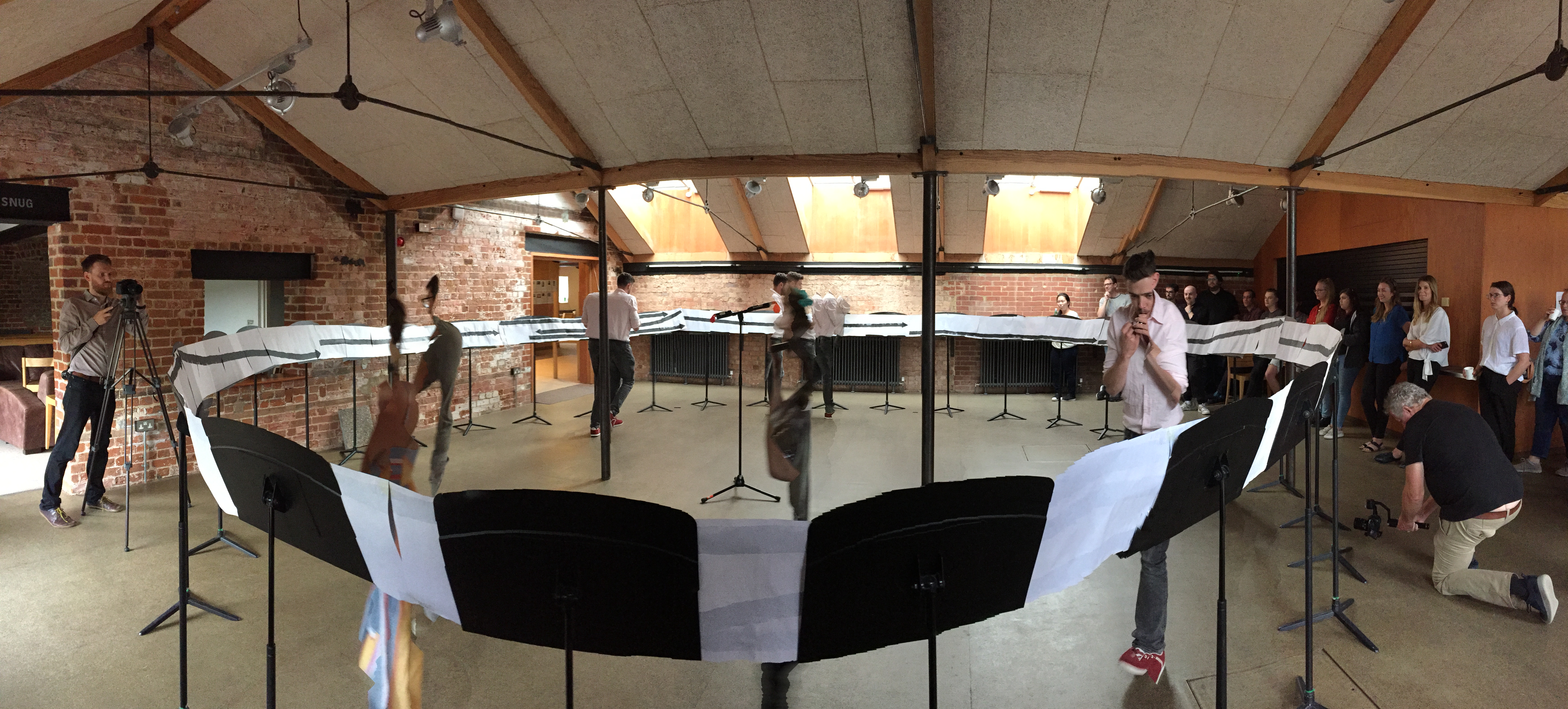
Summer update part three: I had a lovely time working as a tutor on the CAPPA course at Snape Maltings directed by Larry Goves. Although Tim and I dropped in only right at the end when the composers were busy finishing off pieces, it was fantastic to work with them where we could. Tim and I did a short set with new work in progress by each of us, and it was very useful to get feedback from everyone. It was a really astonishing group of people, who made pieces for each other to play, working with The House of…
-
Nadar Summer Academy
Second update from the summer: I was at the Nadar Summer Academy in Sint Niklaas to work with the students on a new piece commissioned by Transit Festival and Matrix New Music for Nadar. The academy is an amazing week of intensive work with the students, who are aged between 14-21. We stayed in a retreat in the countryside near the city, started the day with yoga, cycled the 10k to the music school, ate amazing food, and worked very hard on the pieces. The students were amazing, and did an astonishing job of performing the pieces. The piece I…

-
on tour in Norway
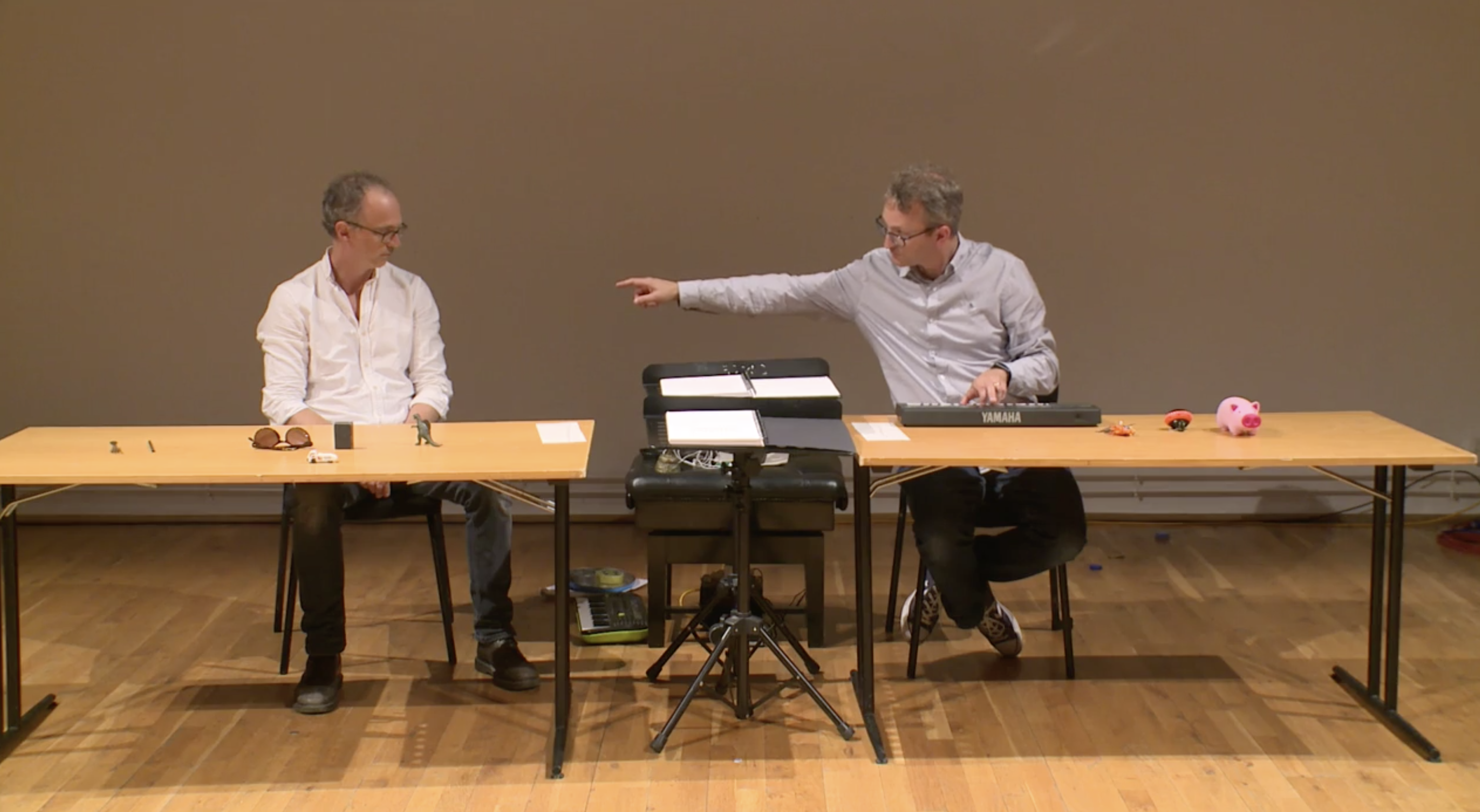
We’re just gearing up for a Parkinson Saunders tour of Norway with Michael Duch at the end of October. We’ll be playing in Bergen (30/10), Trondheim (31/10), Inderøy (1/11), Oslo (2/11) and Tønsberg (3/11). The programme will be a mix of Parkinson Saunders duos, solos by Michael, and trios for all of us. We’ll probably do some versions of Tim’s as yet untitled piece that is a wonderful compendium of short sequences played independently (mostly). We tried this out for the first time over the summer at Snape Maltings as part of the CAPPA summer school organised by Larry Goves. I…
-
new piece for wind orchestra
I’m heading out to Heidenheim on 1 July for the first performance of a piece written for the youth wind orchestra from the Musikschule Heidenheim. This was a commission from Netzwerk Neue Musik through the 2017 ad libitum prize and is one of four pieces being played by groups from the school. I’ve been watching rehearsals on video which has worked really well, and very much looking forward to working with the students next month. The piece is titled solutions must be sought which everyone can accept, and uses a large group of players who continually form new sub-groups until…

-
Recent scores available to download
I’ve just added a load of pieces from the last couple of years to the scores page, including the pieces for Tectonics and Donaueschingen. These are free to download, and if you want to perform any of them just let me know.

-
Group Behaviours talk at Sound and Participation
In February I took part in the Sound and Participation seminar in Gent, organised by Q-O2, Ictus, and hosted at Kask & Conservatorium School of Arts Gent, supported by the Interfaces project (Creative Europe). I’ve been giving variations of this talk over the past few months, and the video of the Gent version is below for anyone who is interested. In it I discuss the role of games, rules, and values as a means to frame group behaviours in some of my recent work. The presentations by the other speakers can be seen here.

-
Here’s the video of the Ictus Ensemble concert at Donaueschingen Musiktage from Saturday, which included my piece know that your actions reflect within the group. The programme also includes pieces by Francesca Verunelli, Hanna Eimermacher and Martin Schüttler. The recording is from the third performance as some of the concerts were repeated multiple times to enable the audience to see everything. It was fantastic to work with Ictus, and they were incredibly committed to playing with the piece over the week we worked together. My piece starts at around 13’44 after a spoken intro.

-
Table layouts
I’ve been working on the setup for my Donaueschingen piece with Tom Pauwels from Ictus Ensemble this week. The piece is for eight instrumentalists, each with a table of auxiliary instruments and an iPad playing back samples through a local speaker. We’re working on the logistics, so Tom has mocked up this plan. I really like the printed placeholders for some of the objects, although the whoopee cushion will be something else. Table layout is something I’m always thinking about when playing with Tim in Parkinson Saunders. We often have some quick resets needed, and I try to be as…

-
New piece for Arditti Quartet and Ensemble Modern
I’m about to start working on a new piece for Arditti Quartet and Ensemble Modern commissioned by Wien Modern for 2018. The festival theme is security, and the piece is going to explore social relationships between two unequal groups as a mechanism for generating the music. I am seriously excited about this project, especially as the piece will be paired with Brian Ferneyhough’s Umbrations. The festival will also include a performance of interspersed sometimes with weeds and brambles which I wrote for the Ardittis in 2013.

-
sometimes we do what you say, but occasionally we don’t
Here are two videos of the latest piece in my things to do series, sometimes we do what you say, but occasionally we don’t. The piece uses the normal cueing system but the cues are given by audience members who step up to microphones to direct the ensemble. The first performance was by Grand Orchestre de Muzzix at La Malterie, Lille in April, and then we played it at the Performing Indeterminacy conference in Leeds at the end of June. Le Grand Orchestre de Muzzix, La Malterie, Lille, 25.04.17 Performing Indeterminacy conference, Clothworkers Centenary Concert Hall, University of Leeds, 30.06.17

-
Donaueschingen piece nearly complete
I’ve nearly sorted out my piece for Ictus for this year’s Donaueschinger Musiktage after a few months of failing to make decisions. That is, of course, the fun part though. The piece continues the use of samples and words as cues that I began in like you and like you, and my recent orchestra piece alternate between attention and ease. This time there are eight players, each of whom have a selection of words and samples to play back that are associated with specific instrumental sound types. The cueing is a lot more dense in this piece though, and will require the…

-
marking up parts
The instrumental parts for my orchestra piece arrived in the post this week, having been sent back after Tectonics by the BBC Music Library. As I tell all my students, look at what the players write on your parts as it will tell you a lot about what they need to know. Mostly, in this case, it was lovely drawings. As I mentioned in the previous post, there was some discussion about the ease of finding each cued pitch on the score. I deliberately made this a little tricky to lengthen the time it might take to respond to cues.…

-
alternate between attention and ease
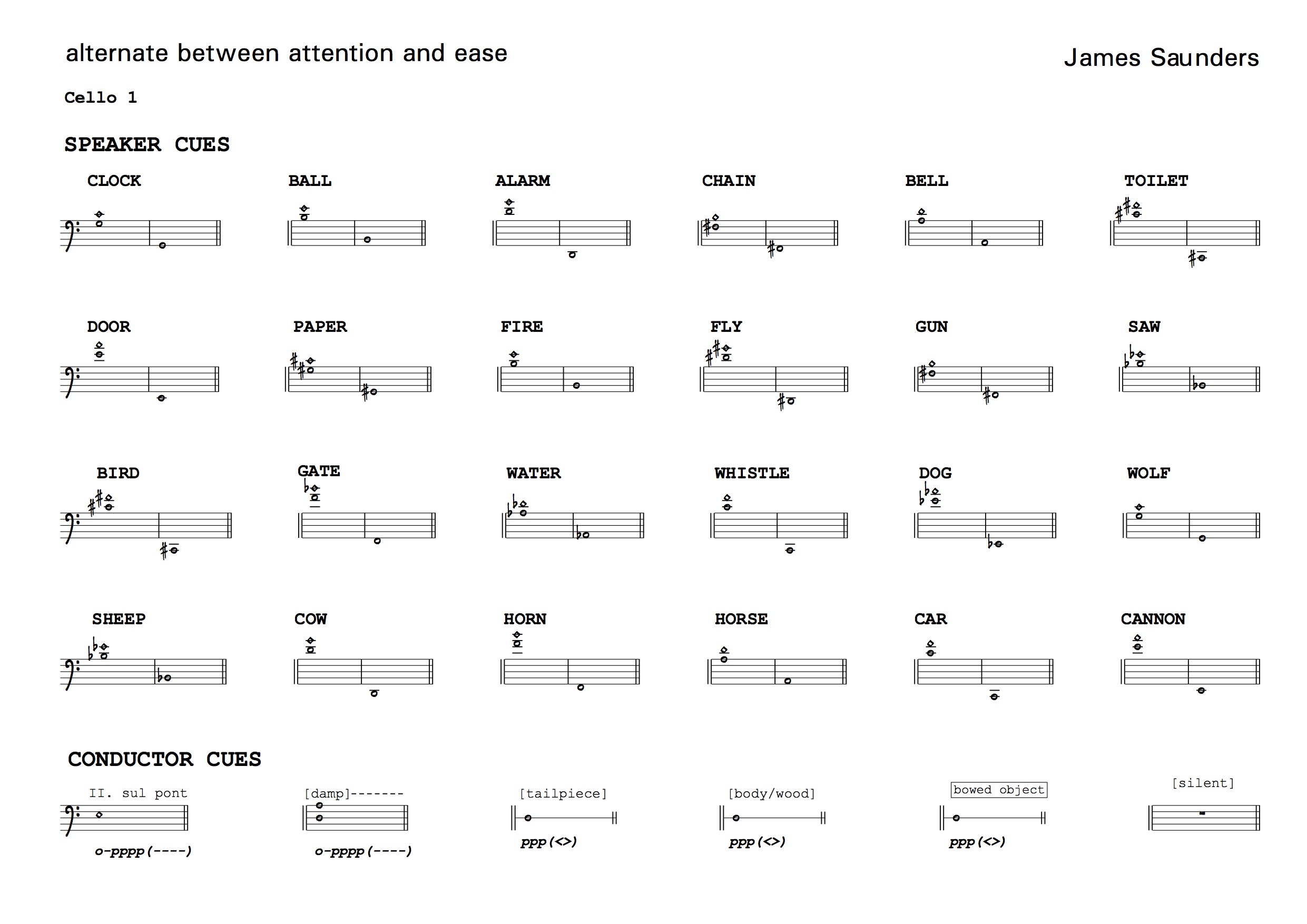
We had a great rehearsal yesterday with the BBC Scottish Symphony Orchestra and Ilan Volkov. It was a long trip (Parkinson 398 miles, Saunders 374 miles) and an early start, but great to get the piece sorted with the orchestra, who were lovely to work with and very patient. I was really pleased with how it went, and there was a lot of very useful discussion with some of the players about the rationale for the score layout. The players have to take aural cues (words, samples) and associate them with labelled pitches on the parts. I deliberately didn’t put…
-
all voices are heard
Here’s a video of all voices are heard being played by Material and OUT-TAKE Ensemble in Bath at the Ludo2017 conference last week. We chose to do it with words and objects for the first time, and it’s a format that I really like. The words were chosen by random and grouped into arbitrary sets for each sequence. The objects were sourced by group members and placed on the tables in the same positions to facilitate a kind of visual memory for actions. This is one of two performances of the piece in four days: I’ll upload the version played by…

-
a piece for orchestra and Parkinson Saunders
My new orchestra piece for Tectonics is done. It’s called alternate between attention and ease and will be performed by me and Tim Parkinson with Ilan Volkov and the BBC Scottish Symphony Orchestra in this year’s festival on 7 May. There will be speaking, sound effects, noises and lots of major and minor chords.

-
no videos
All the Vimeo videos of my work are currently unavailable as we are just reworking our institutional subscription at Bath Spa. They should be back soon I hope.

-
do the best you can
I’ve been thinking more about games over the past week as I’m working through Mary Flanagan’s Critical Play, and trying to finish my orchestra piece. The thing which draws me to games as a basis for music (apart from the fact they are fun) is the sense of purpose they present. The last couple of posts I’ve made consider this, but this morning I’ve been looking back at some other recent work and thinking about other models. In particular, the context of a psychology experiment is possibly a different model to consider. Of course, this is a highly abstracted, non-empirical and…

-
end condition
Since beginning to tag my pieces, I’ve been looking at which of them might qualify as games. Perhaps unsurprisingly, it’s very few: only three. Although I’ve been investigating games a lot over the past year, I’ve not really translated some of the core requirements for the pieces to fit any of the common definitions. I find Chris Crawford’s taxonomy a useful one. Most of the pieces I’ve made are interactive, and they often feature competitors who make ‘attacks’ on other players – or at least influence their actions. There are also activities and rules that constrain behaviours, but very few…
-
series, groups, tags?
I like to categorise and organise things. I like groups of related items, and looking at the features that they have in common and those that distinguish them. For me, this is a useful creative strategy. When applying it to pieces, it helps me think about what I’ve already done, and what a small change to a piece might do to turn it into something different. A number of my pieces have strong relationships between them, sometimes sharing a similar mechanism such as with the things to do series, or having a common structural principle, such as some of the template…

-
finding word associations
I’m trying to find a satisfying set of words and sounds to use as cues for my orchestra piece at the moment. Each cue needs to be the name of something that makes or describes a sound, and then I also need a sample for each sound. For the past month I’ve been thinking through using objects as well, but the orchestra players will only respond to sound (spoken text or the sounds themselves), so there seems little purpose in using objects in addition. I’m using multimodal cues, so the noun representing the sound sources (dog, gun etc) and samples of the…

-
no mapping in Glissando
Polish journal Glissando has just printed a translation of the short text no mapping that I wrote for MusikTexte this year. It’s part of an issue exploring conceptualism and appears alongside Jennifer Walshe’s text on New Discipline and Matthew Shlomowitz’s on automata from the original volume, as well as texts by Volker Straebel and Harry Lehmann.

-
new orchestra piece nearly done (probably)
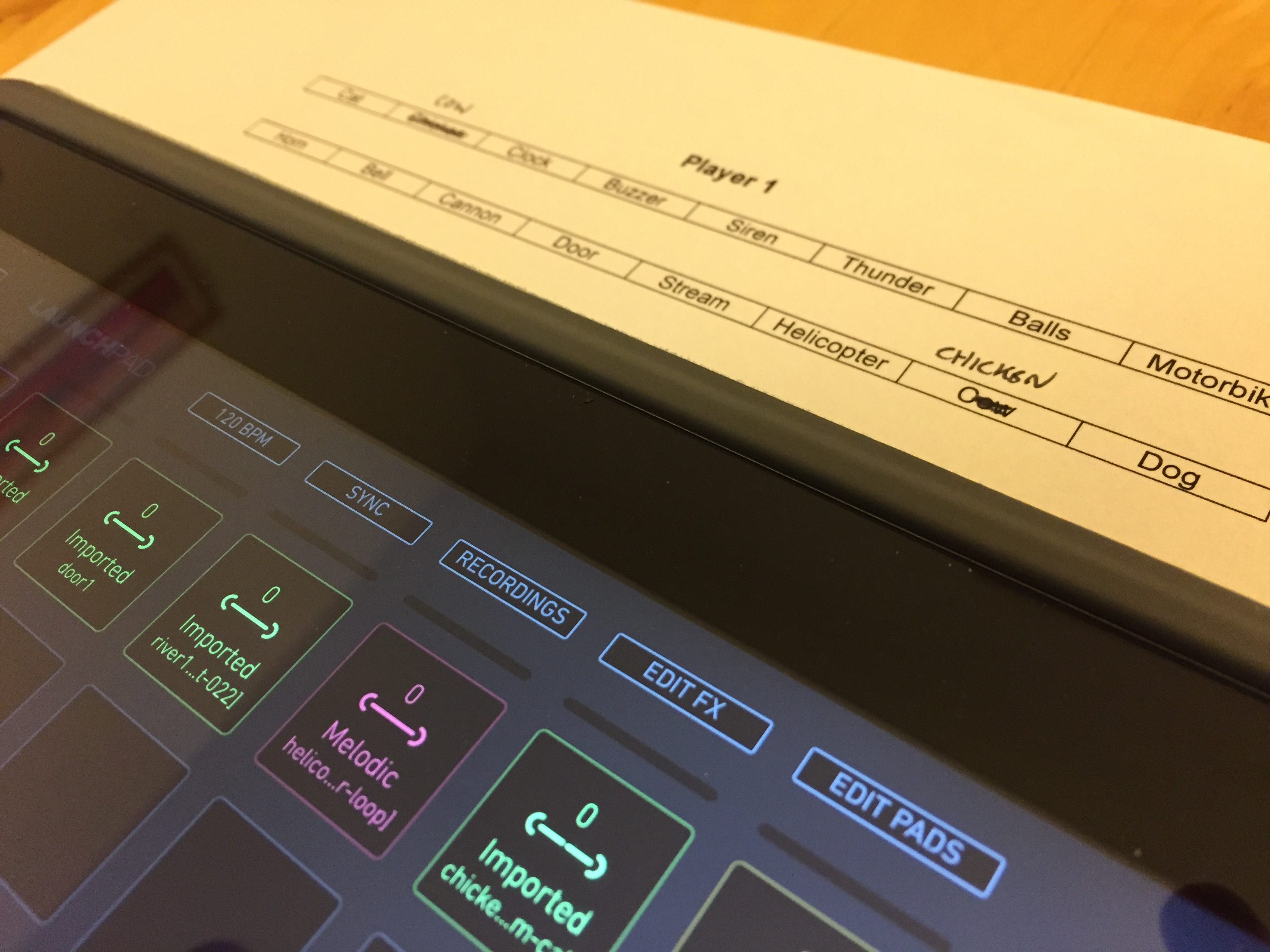
I don’t have a title for my new orchestra piece yet, but it explores cognitive load and the way we remember associations between pairs of unrelated elements. Cognitive load is the amount of mental effort needed to remember things in different situations. An example of it in practice is the children’s party game where a tray of objects is displayed before being hidden, and then participants are asked to remember as many of the items as possible. The difficulty of this task is affected by the number, type and arrangement of the objects. My new piece draws on two previous pieces, like…
-
values and motivation
I’ve been reading Mary Flanagan and Helen Nissenbaum’s Values at Play as I’m exploring the ways in which theory developed through game studies might be applied to music. At the moment my interest is in how games can provide motivation for players as this is not always explicit in music. Of course there is a kind of obvious motivation, that players like to play music because it is an emotionally, physically and socially fulfilling activity. But specifically in indeterminate pieces, where players are faced with choices, it is not always clear why they should do one thing over another. Given a range…

-
surfaces in Buffalo
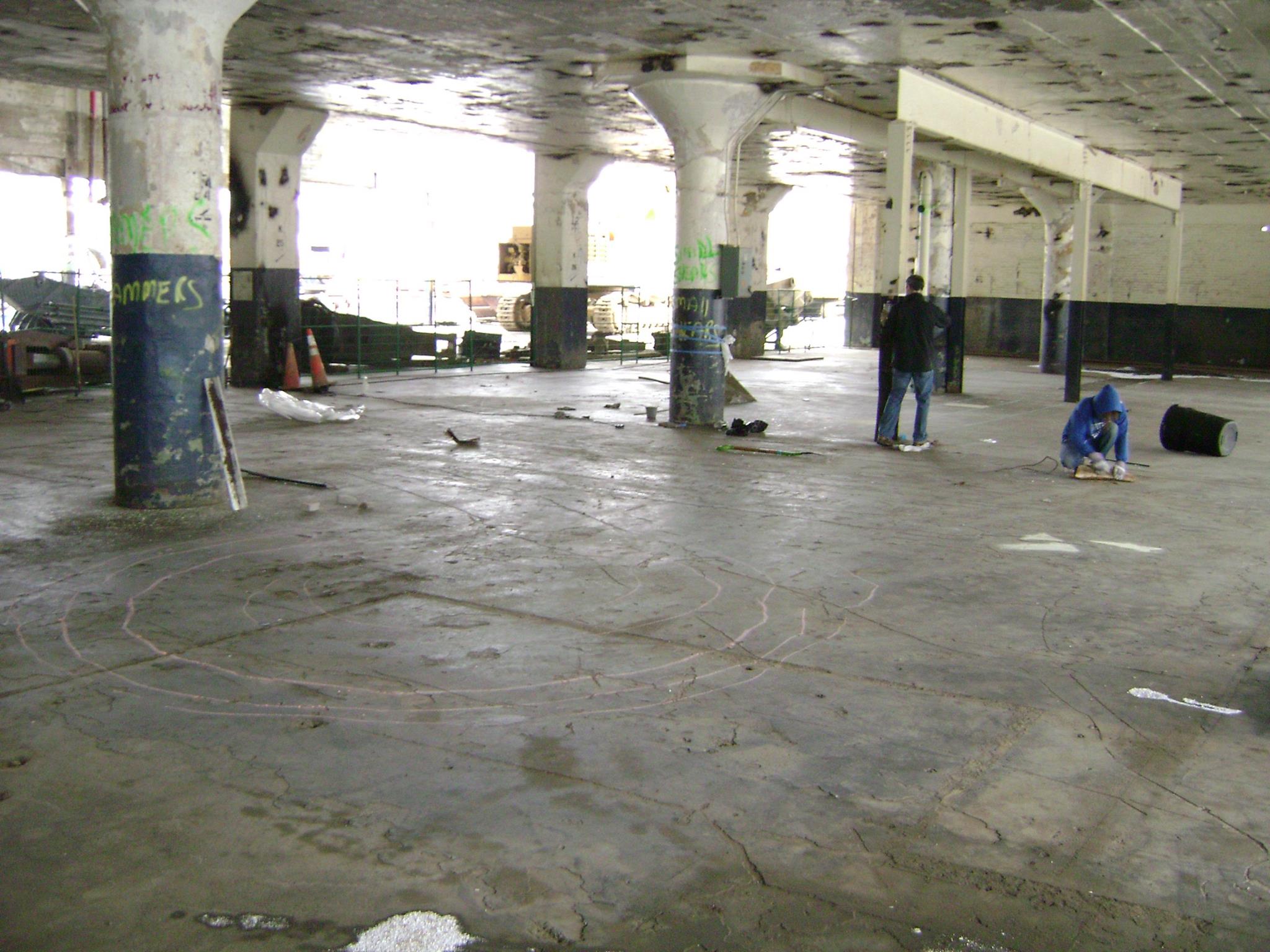
Colin Tucker has posted some documentation of the realisation of surfaces that he organised in May, as part of his null point series in Buffalo’s Echo Art Fair. It was performed at the Buffalo Gear and Axle Plant, with all the sounds being drawn from the floor of this decaying industrial space. The performers were Bob Fullex, Ethan Hayden, Zane Merritt, Colin Tucker, David Wegehaupt, and audience members. It’s great to hear a version that uses site-specific materials to generate the sound.
-
generic/specific
I’ve been reading a lot of game studies texts at the moment that are suggesting some useful ways forward. In particular, applying the frameworks of play, purpose and values developed by game designers and academics to music has presented me with some useful ways to begin thinking about how to develop open scores that rely on interpersonal interaction. One aspect of this is my ongoing consideration of specificity with regards to how a composition becomes fixed. I find myself making two types of pieces on the whole: those that are very open or general and could be realised in many…

-
constant interchange of the most various kinds
The piece I wrote for CoMA’s Partsong Book was performed in the summer at the CoMA Summer School by participants in the course. The piece is for a small ensemble of at least three players, each of whom has six sound sources: a field recording played back through headphones laid on the table, a spoken text which relates to the recording, an object which also relates to the recording moved across the table, breath noise, singing and whistling. Like a lot of my pieces, all of these sounds are played back at minimal volume in order to destabilise them and…

-
notebook angst
My notebook is about to run out of space again. I am finding myself hanging around art shops and stationers with a slightly nervous need to buy things. I don’t know whether to get a refill – it’s a modular notebook folder that I can refill – or do something different for a while. It’s been a perfect solution for the last four years, but I wonder if having this one way to think about ideas is too leading in the kind of work I produce. In particular over the past couple of months while working on an orchestra piece…

-
Open Scores Lab
The new research group I’ve initiated at Bath Spa University meets for the first time on Wednesday 7 October. Open Scores Lab brings together creative practitioners and researchers in a range of disciplines including composition, improvisation, visual art, performance art, graphic design, and creative computing. We’ll be looking at approaches to score making and giving instructions in a range of different contexts, including music. Each meeting will feature staff and PhD researchers at Bath Spa, and a visiting speaker. I’m super excited about this year’s group of speakers, who are Michael Winter, Cassandra Miller, David Pocknee, Jennifer Walshe, Matthew Shlomowitz,…

-
#030501 [1-2] / #200501 [1-3]
#[unassigned] (#180700–#201201) by James Saunders #[unassigned] (#180700–#201201) by James Saunders #[unassigned] (#180700–#201201) by James Saunders #[unassigned] (#180700–#201201) by James Saunders These versions were made for Apartment House for their two-date UK tour, organised by BMIC Cutting Edge. This was an offshoot of the series in London at The Warehouse the previous autumn. The ensemble comprised Anton Lukosevieze (cello), Andrew Sparling (clarinet), Alan Thomas (guitar) for Nottingham, and they were joined by Lore Lixenberg for the Brighton date. There were two versions for the trio played in Nottingham at Djagnoly Hall, and these were repeated in Brighton at the Pavilion Theatre, separated by…
![#030501 [1-2] / #200501 [1-3]](https://www.james-saunders.com/wp-content/uploads/2016/08/royal_pavilion_onion_domes_brighton_uk_may_2011.jpg)
-
New piece for Donaueschingen 2017
I’m just beginning to work on a new piece for Ictus Ensemble, commissioned by Donaueschingen for performance at the 2017 festival. I’m at the early stages at the moment, but it will involve group decision making in a medium size ensemble of about 10 players, using a combination of instruments and other materials. Lots to do.

-
Experimental music since 1970
I’ve just finished Jennie Gottschalk’s Experimental Music since 1970, recently published by Bloomsbury. It’s a really useful book, with a ton of information about many practitioners, a lot of whom I know, and many I’ve not come across. It’s difficult to take in the wealth of detail at first reading as there is so much music referred to, but I think it’s going to be a very useful resource for ongoing reference, especially given the thematic grouping of approaches. It’s great to see so many people discussed in detail, and it’s such a timely book in that regard. I think we’re at…

-
840 on tour
Alex Nikiporenko and Nick Peters’ 840 series will be on tour in September, playing in Birmingham, Manchester and Bristol. Joined by violinist Ruben Zilberstein, the programme includes the piece I wrote for the London performance, in which one thing depends on another. The programme also includes pieces by Alex, Nick, Jennifer Walshe, Laurie Tompkins, Michael Baldwin, Vitalija Glovackyte, and Dominic Lash. Details on the 840 website.
